|
Man-portable air defence systems (MANPADS), commonly described as shoulder-fired anti-aircraft missiles, are short-range surface-to-air missiles (SAMs) designed to be carried and operated by a single individual or a crew of several individuals. They are small, light, missile-launching weapons designed to be fired by an operator on the ground against a target in the air.
MANPADS pose a threat to all types of aircraft and concern has been raised over attacks on civilian aircrafts, especially following the attempted shooting of an Israeli airliner in Mombasa, Kenya in November 2002. Although the two SAMs luckily missed the plane, the attack increased the possibility that terrorists are capable of mounting such attacks, and with increased chances of striking the targets. A missile attack, whether it succeeds or fails to strike its target, destabilises the socio-economic state of both the country and the region in which the incident occurs.
Unending conflicts characterized by the large number of armed groups across sub Saharan Africa continue to attract illicit arms traffickers. The situation is further worsened by weapons leaking from poorly secured arsenals of failing states as well as those in conflict. A combination of these factors renders MANPADS relatively cheap and easy to access.
MANPADS have been the focus of unprecedented media attention since 2002. A symptom of recent attacks, public alertness to the threat they pose to aircrafts, is arguably greater than ever before. Much of this attention centres on the fear of terrorist attacks, although MANPADS have been, and still are, used primarily in war zones. Most countries in the Great Lakes and the Horn of Africa regions are emerging from prolonged conflicts while others have pockets of instability within their borders. The use or possession of MANPADS in such countries cannot be ruled out. The availability of such weapons means that in situations where they are no longer needed for war purposes, they can be sold out or used for illegal purposes.
Against a backdrop of often-conflicting reports, RECSA commissioned a study seeking to clarify some of the basic trends in MANPADS proliferation in the Great Lakes Region and Horn of Africa.
The report of the study is ready and RECSA is hosting a regional seminar in Nairobi, Kenya where the findings and experiences from other parts of the world will be shared.
It is important to have information on MANPADS proliferation in the region, the threats they pose to regional security and what can be done to counter the dangers they pose. With the increasing air traffic in the region, an understanding of any related insecurity that MANPADS could pose is crucial.
The objectives of the seminar are to among other things;
a) To dialogue on the study that explores the flow of MANPADS in the Great Lakes Region and Horn of Africa.
b) To offer a platform for the sharing of experiences and best practices on MANPADS management from other parts of the world.
c) To take stock of the current intervention initiatives by Member States (e.g. Destruction) and assess their successes and challenges
d) To initiate regional dialogue and best practice guidelines on MANPADS management and control for the RECSA region.
The UN Office for Disarmament Affairs is hosting the third Biennial Meeting of States (BMS3) to review the implementation of the UN Programme of Action to Prevent, Combat and Eradicate the Illicit Trade in Small Arms and Light Weapons in all its Aspects from 14th to 18th July 2008 at the UN Headquarters in New York.
This gathering has over the years provided a platform for States and other stakeholders to share ideas on international cooperation to tackle the problem posed by the proliferation of illegal small arms and light weapons.
The Regional Centre on Small Arms (RECSA), which now enjoys Observer Status at the UN, has been invited to participate in this year’s meeting. RECSA will host a side event on the theme Arms Marking and Tracing in the Great Lakes Region and the Horn of Africa on Wednesday 16th between 1:15 p.m. and 2:30 p.m in Conference Room 4 at the UN Headquarters.
RECSA has procured electronic arms marking machines for its 12 Member States who have committed themselves to marking all weapons in State possession by December 2008. Rwanda, for example, has started marking its arms manually. This is an extremely slow exercise! The machines, which will be distributed to the various countries, will speed up the process and enable them to meet the deadline.
The side event will comprise a series of presentations and discussions on the theme. Participants will include Heads of RECSA Member States accredited to the UN,international and civil society organisations, donors, among others.
Exhibition
Throughout the BMS3 week, RECSA will have a stand at the UN exhibition hall to create awareness about its work in the Great Lakes Region, the Horn of Africa, and Bordering States in addressing the proliferation of small arms and light weapons.
Our various publications and other communication material will be available to visitors at our stand for free.
Regional
Center on Small Arms and Light Weapons (RECSA)
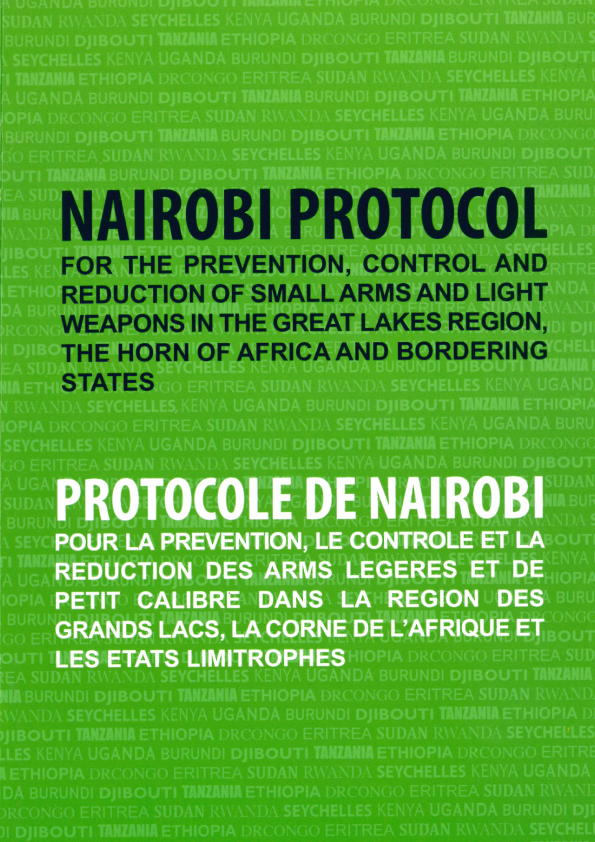
is an institutional framework arising from Nairobi
Declaration to coordinate the joint effort by
National Focal Points in Member States to prevent,
combat and eradicate stockpiling and illicit
trafficking in small arms and light weapons in the
Great Lakes Region and Horn of Africa.
Nairobi Declaration on the Problem of Illicit Small
Arms and Light Weapons in the Great Lakes Region and
the Horn of Africa was signed on the 15th March 2000
by the Ministers of Foreign Affairs and / or
Representatives of the Governments of Burundi, DRC,
Djibouti, Ethiopia Eritrea, Kenya, Rwanda, Sudan,
Tanzania and Uganda. |